
What is Java?
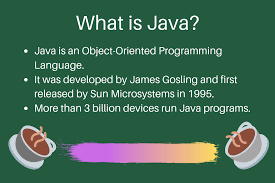
A Java program is a computer program written in the Java programming language. It is a widely used, high-level, object-oriented programming language developed by Sun Microsystems (now owned by Oracle Corporation). The programs are typically compiled into bytecode that can be executed on any device with a Java Virtual Machine (JVM), making the applications highly portable across different platforms. The programs are used for a variety of purposes, including web development, mobile app development, enterprise software development, and more.
Table of Contents
History of Java
The is one of the most popular programming languages worldwide. It was created by James Gosling and Patrick Naughton, employees of Sun Microsystems, with support from Bill Joy, co-founder of Sun Microsystems. Sun officially presented the program language at SunWorld on May 23, 1995.
What are the features of Java Programing Language

It is a versatile and powerful programming language with numerous features that contribute to its popularity and widespread adoption. Here are some of the key features of the programming language:
- Simple and Easy to Learn: It was designed to be easy to learn and use, with syntax similar to C and C++ but without the complex features like pointers and operator overloading.
- Object-Oriented: It is a fully object-oriented programming language, which means it supports concepts such as classes, objects, inheritance, encapsulation, and polymorphism.
- Platform Independence: The programs are compiled into bytecode, which can run on any device with a Java Virtual Machine (JVM), making the platform-independent and highly portable.
- Automatic Memory Management: The features automatic garbage collection, which automatically deallocates memory no longer in use, reducing the risk of memory leaks and making memory management easier for developers.
- Robustness: The robustness is achieved through features such as strong type checking, exception handling, and memory management, which help prevent errors and ensure reliable and stable performance.
- Security: The incorporates built-in security features such as bytecode verification, sandboxing, and security managers to create secure applications and protect against vulnerabilities.
- Multi-threading: It supports multi-threading, allowing developers to create concurrent and parallel applications that can take advantage of modern multi-core processors for improved performance and responsiveness.
- Rich Standard Library: The comes with a comprehensive standard library (Java API) that provides pre-built functionalities for common tasks such as networking, file I/O, database access, GUI development, and more, saving time and effort for developers.
- Scalability: The applications are scalable and can be easily scaled up or down to handle increasing or decreasing resource demands, making them suitable for a wide range of applications from small desktop programs to large enterprise systems.
- High Performance: While Java may not be as performant as lower-level languages like C or C++, it offers reasonable performance for most applications and benefits from ongoing optimizations and improvements in the Java Virtual Machine (JVM).
- Community and Ecosystem: The has a large and active community of developers, providing extensive resources, libraries, frameworks, tools, and support to facilitate development, troubleshooting, and best practices.
These features collectively contribute to Java’s popularity and versatility as a programming language, making it a preferred choice for a wide range of application development scenarios, including web development, enterprise software, mobile app development (Android), scientific computing, and more.
What is Object Oriented Programming Languages

Object-oriented programming (OOP) is a programming paradigm based on the concept of “objects,” which can contain data, in the form of fields (often known as attributes or properties), and code, in the form of procedures (often known as methods). Languages like Java, C++, Python, and many others support object-oriented programming principles. In OOP, objects can interact with each other through methods, forming the basis for modular and reusable code.
What are the uses of Java programming language
- Web Development: It is used for server-side web development with technologies like Servlets, JSP, Spring, and Hibernate.
- Enterprise Applications: It is widely used for building large-scale enterprise applications due to its scalability and reliability.
- Android App Development: It is used for developing Android applications, providing compatibility across a wide range of devices.
- Desktop GUI Applications: Java’s Swing and JavaFX libraries enable developers to create cross-platform desktop GUI applications.
- Backend Development: The powers the backend of web applications, handling business logic and interacting with databases.
- Big Data Technologies: It is used in big data processing frameworks like Hadoop and Spark, as well as stream processing systems like Kafka.
- Financial Applications: Java’s strong type system and robustness make it suitable for building financial applications such as trading platforms and banking software.
- Scientific and Research Applications: It is used in scientific computing and research projects for numerical computation and data analysis.
- Gaming: It is used in game development, particularly for browser-based and mobile games, with libraries like LibGDX.
- Educational Purposes: It is commonly used in educational settings for teaching programming concepts due to its simplicity and widespread use.